
AI for Property Management: Tenant Calls, Leasing Leads and Maintenance Requests
Where AI actually helps a small property manager: leasing inquiries and showings, after hours tenant calls and repair requests, simple automation like entry notices, and the TAL, LTB and Law 25 rules to build around.
Where does AI for property management actually help? Right now, mostly with the messages. It can answer prospects asking about a unit, book showings, take a proper repair request from a tenant at 11 at night, and get the real emergencies to whoever is on call. The decisions about rent, leases and disputes stay with your people. I'm writing this for smaller property managers in Quebec and Ontario, the kind of company with a few hundred doors and an office of three or four.
The problem usually isn't software
When I talk with people who run a smaller portfolio they rarely tell me they're missing a tool. What they tell me about is the phone. Somebody answers the same questions all day, is parking included, can I have a cat, is heat in the rent, and in between there's a plumber waiting on a callback and a tenant upstairs with water coming through the bathroom ceiling.
Leasing got a little harder in the meantime, at least in Montreal. CMHC's 2025 Rental Market Report has the purpose built vacancy rate in Greater Montréal going up a second year in a row, to 2.9%, with some landlords offering free months to fill units. Toronto was at 3%, first time since the pandemic. Vancouver was 3.7% and CMHC says that's the highest there since 1988.
Those aren't huge numbers. Still, someone looking at your two bedroom on a Saturday has more choice than they did two years ago, and if nobody writes back until Monday they've probably booked a visit somewhere else by then.
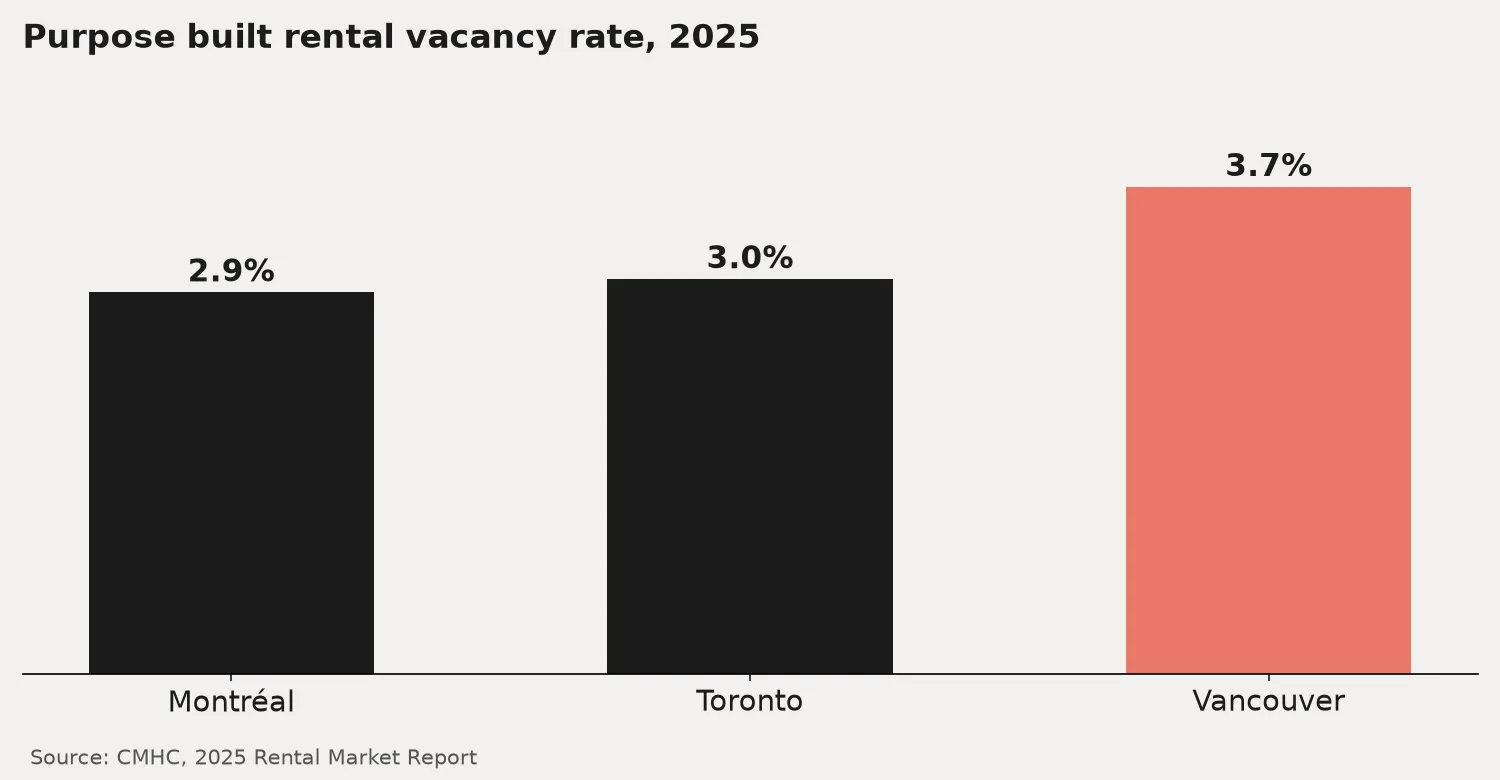
Source: CMHC, 2025 Rental Market Report, purpose built rental vacancy rates.
What does an AI leasing assistant do?
It answers the person who asked about the unit. By email, text, sometimes the phone. It says what's free and about what it costs, asks when they want to move in, and puts them in a showing slot on your calendar.
The biggest name doing this is probably AppFolio. In a June 2026 announcement they said their Leasing Performer, already on email and text, now takes phone calls too, around the clock and in several languages, and that property managers using it saw showings booked go up by more than 35% on average. That's AppFolio's number about AppFolio's product, so take it for what it is. I believe the basic part though. Lots of people apartment hunt late at night once the kids are down, and the first landlord to answer has a head start.
In Quebec I'd test the French before anything else. AppFolio's page on the voice version lists French, which is good. I'd still want to hear it handle a real conversation with somebody from Rosemont first.
One rule to build in. The TAL page on access to the dwelling says showings of a unit being rented have to happen between 9 a.m. and 9 p.m., and the current tenant can ask that you or your representative be there. So the software booking visits needs to know those hours, and it can't just send someone over alone with the lockbox code.
Answering service or AI receptionist?
For the phone after hours you've got two choices. A property management answering service is usually real people answering in your name, taking messages and paging whoever's on call. An AI receptionist for property management is software that answers first, handles easy things itself, and only calls a person when it should.
Here's a normal one. Sunday, 9 p.m., the dishwasher won't drain. The assistant picks up, says it's automated, asks for the building and the unit, asks for a photo by text, and opens a work order so the tenant knows Monday someone will follow up. Nobody gets woken up for a dishwasher.
Water through the ceiling, or no heat in January, is not that. Those should get to a human right away, and in Quebec there's a practical reason beyond keeping tenants happy. On its page about urgent and necessary repairs the TAL gives examples like major plumbing or roof leaks, bad wiring, a blocked sewer, heating problems in winter and locks that don't work. If the tenant can't reach you, or you don't act in time, they can have the urgent repair done and hold back the reasonable cost from the rent.
I'd honestly just start from that page. Everything on it is something the AI passes to a person and never tries to sort out. Then add your own.
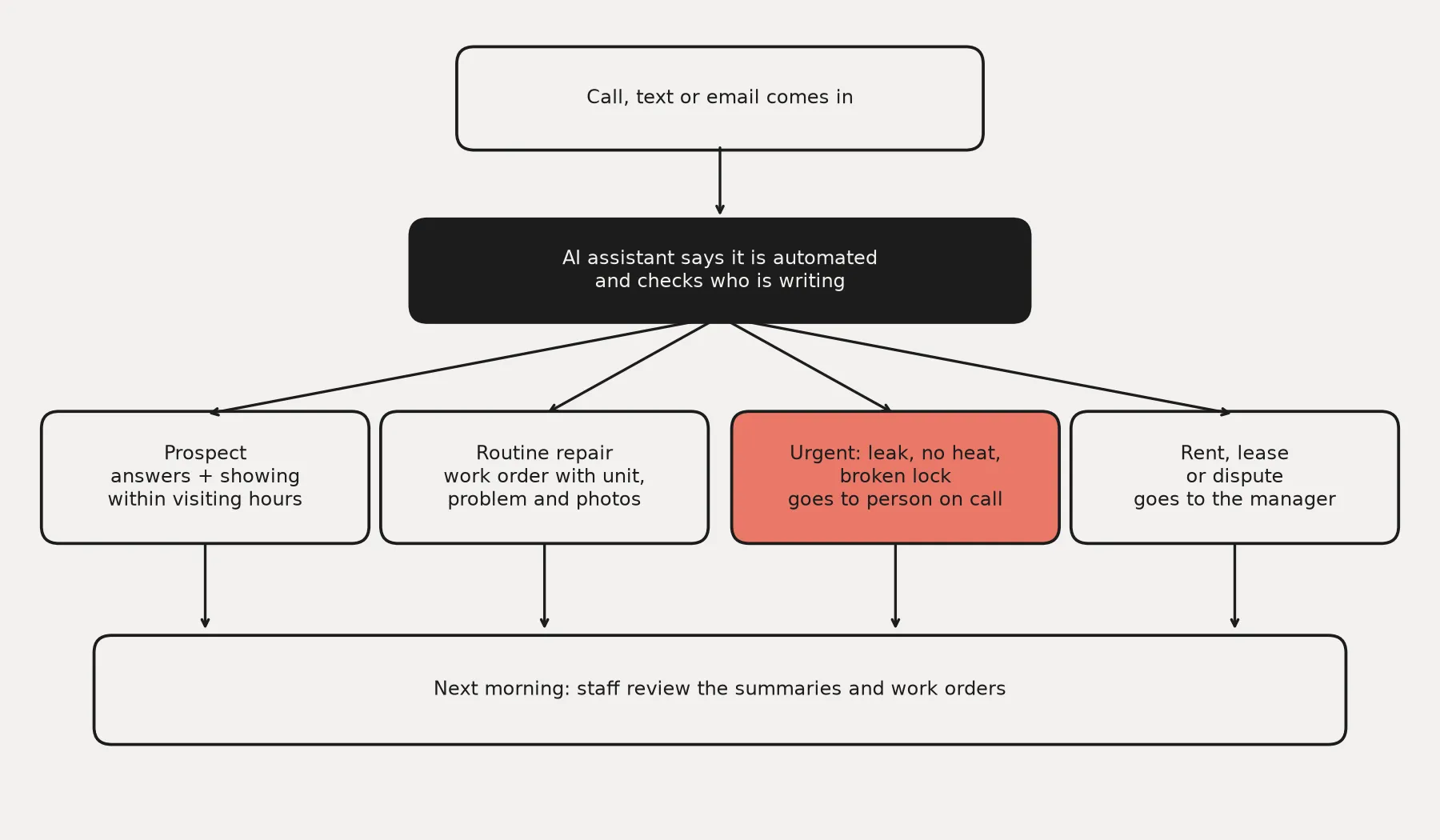
How a tenant or prospect message can flow from an AI assistant to the right person.
Not everything needs AI
Plenty of what gets sold as AI property management is plain automation. For a small company that's often where I'd begin. Rent reminders. Renewal reminders. The move in email. A text to the contractor the day before. None of it needs a language model, somebody just has to set it up once. Letting prospects pick their own showing time is mostly booking automation on top of the calendar you already have.
Entry notices are a good example. Ontario's Landlord and Tenant Board, in its guide to the Residential Tenancies Act, says you usually need 24 hours written notice to go in for repairs or an inspection, with the reason and a specific time between 8 a.m. and 8 p.m. The TAL says 24 hours in Quebec too, verbal or written, with repairs between 7 a.m. and 7 p.m. unless it's urgent. A template that fills that in and sends it is easy, and you get a record of when it went out.
Where it does need AI is the reply. The tenant writes back that Tuesday won't work because they sleep days, could the plumber come Thursday afternoon? A normal workflow sends the same notice again. An agent can read that, check the plumber's calendar and suggest Thursday for your coordinator to OK. That's the kind of thing we set up with AI agents for property managers.
What about tenant data?
If you already pay for tenant communication software, a portal or an app, look at what AI it has first. A lot of these platforms are adding features, and a separate tool that can't see your work orders mostly just gives you another inbox.
General information, not legal advice, so ask your lawyer. Canada's privacy commissioners put out principles for generative AI in 2023 and one is that people should know when they're dealing with a public facing AI tool. That's why the assistant should say it's automated in its first sentence. Quebec also has Law 25, and the Commission d'accès à l'information explains that before personal information leaves Quebec, even to another province, you need a privacy impact assessment and a written agreement. Tenant files are full of personal stuff. Find out where the vendor keeps the data, and keep the AI away from what it doesn't need, credit checks for example.
So where do you start?
Pick one channel. Probably the after hours maintenance line, since that's where tenants get most frustrated and your staff get most tired. Or leasing inquiries if units are sitting empty. Run it a couple of months and read every conversation for the first few weeks, because you'll learn fast what people really ask and the script will need fixing.
I've written about the same approach for AI receptionists for clinics and gyms, and about AI for law firms and AI for accountants. There's a broader piece on AI agents for small business too.
FAQ
Can an AI receptionist handle emergency maintenance calls?
It can pick them up, but I wouldn't let it decide what to do with them. You give it a list of situations like leaks, no heat or a broken lock that always go straight to whoever is on call.
How is an AI leasing assistant different from a property management answering service?
An answering service is normally real people taking messages for you, while an AI leasing assistant talks to the prospect itself at any hour and can book the showing from your calendar.
Can I use AI property management tools in Quebec?
Generally yes, but Law 25 still applies to your tenants' information, and showings and entry still have to follow the TAL's rules on notice and visiting hours.
Do I need new software to start?
Often not. I'd check what your current property management or tenant communication software already does, and start with simple things like reminders and entry notices.
Next step
If you'd like to figure out whether this would actually help with your buildings, you can book a call with Tom and we'll look at which part of your inbox makes sense to try first.