
AI for Law Firms: An AI Receptionist That Handles Intake and After-Hours Calls
An AI receptionist can pick up the calls and chats a law firm misses, collect intake details and book consults, without giving legal advice. Here's how an after-hours call can flow, how it compares to an answering service, and what the Barreau du Québec and the Law Society of Ontario say about confidentiality and client-facing AI.

When people ask me where AI for law firms should start in a small practice, I usually say the phone, and not the research tools that get most of the attention. An AI receptionist picks up the calls and web chats that nobody at the office can get to, writes down the intake details, and then books a consult or passes the person to a lawyer. It doesn't give legal advice and it shouldn't, so the lawyer is still the one who decides who becomes a client. I'm mostly writing for small firms in Quebec and Ontario, but most of it applies anywhere.
Why the phone comes first
In a small firm the phone is usually covered by whoever happens to be free, often an assistant who also does billing and filing, and when the lawyer is in court and the assistant is on another call the line just rings until it goes to voicemail. Nobody is surprised that calls get missed, but I was a bit surprised by how many. For its 2024 Legal Trends Report, Clio had a research firm call 500 law firms as if they were prospective clients, and only 40% of the firms picked up. Once callbacks were counted, 52% were ever reached, according to Clio's write-up of the study, so 48% couldn't be reached by phone at all, and email did even worse, with 33% of firms replying.
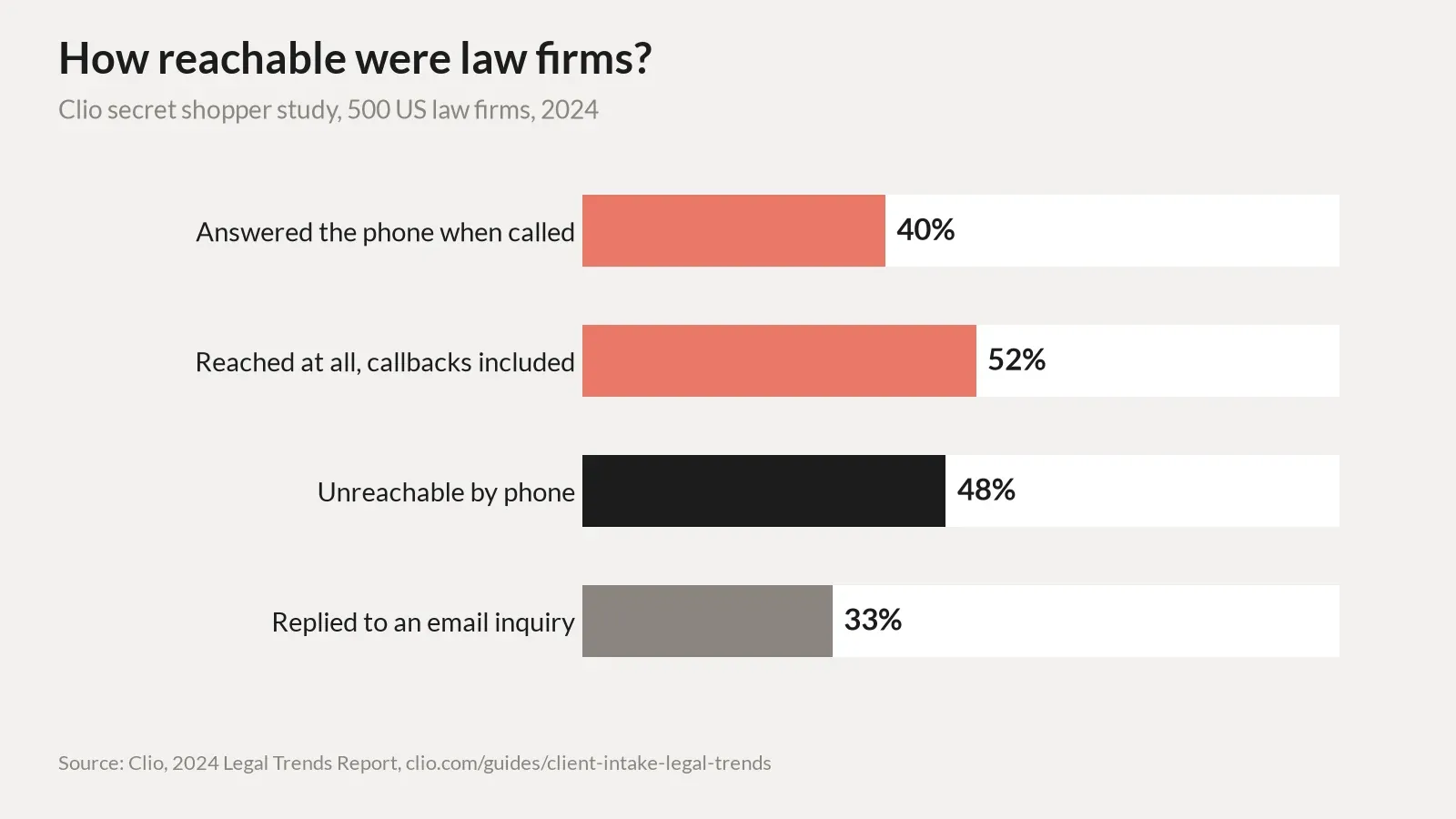
Source: Clio, 2024 Legal Trends Report secret shopper study of 500 US law firms.
That study is American and I looked for a Canadian one and didn't find it, so I can only guess that a two lawyer office in Montreal or Ottawa looks about the same. The other thing is timing, because people tend to look for a lawyer right after something has gone wrong, and that is often in the evening or on a weekend when the office is closed. If all they get is voicemail, a lot of them will just call the next firm on the list, and I probably would too.
What it does with an after-hours call
The way I picture an AI receptionist for law firms is as a very patient front desk that only does what you wrote down for it. Say someone calls at 9 p.m. on a weekday. The agent picks up in French or English, says plainly that it's an automated assistant, and asks what the matter is about in general terms. It takes a name and a phone number, and it asks who the other parties are, which is the question people tend to forget and the one you need later for the conflict check.
Then it checks the matter against the kinds of work you actually do, so if you only do family law and the caller needs help with a commercial lease, it tells them politely that your firm doesn't handle that and points them somewhere else. If the matter fits, it offers a consult time from your calendar or tells them someone will call back in the morning, so either way the caller knows what happens next.
Urgent calls follow a different path that you set up ahead of time. Someone who was just arrested, or who has a hearing tomorrow, gets routed to whoever is on call, or at the very least gets flagged at the top of the morning list, and you decide what counts as urgent so the agent is only following your list and not making its own judgment.
And it never tells anyone what their legal options are. When a caller asks whether they have a case, the agent says that is a question for the lawyer and offers to book a time with one.
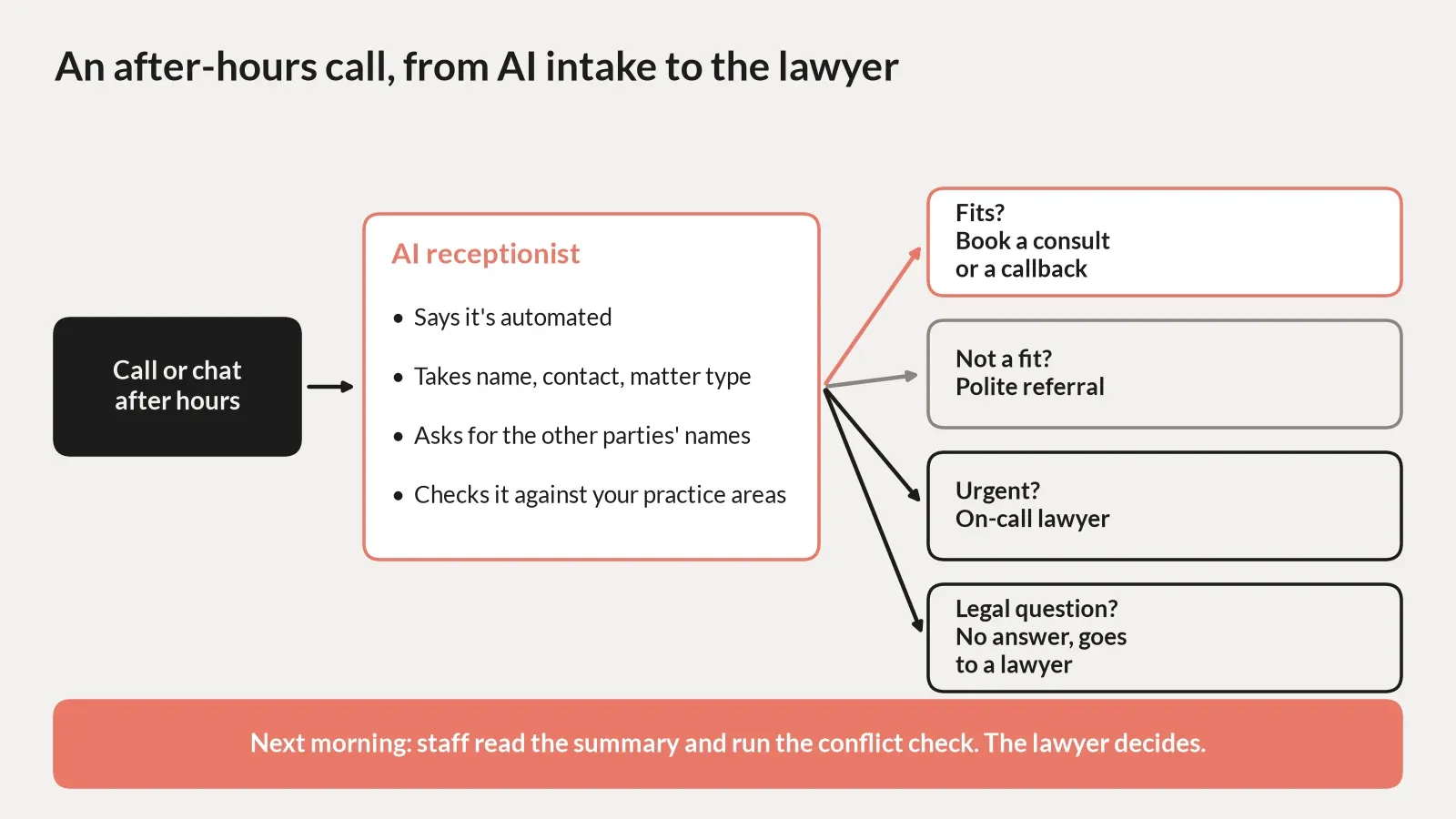
How an after-hours call can flow from AI intake to a lawyer.
The next morning someone at the firm reads the summaries and runs the conflict check, and then the lawyer decides whether to take the matter on. I wouldn't skip that step, because the agent only collects information and the decisions stay with the firm.
Confidentiality and conflicts in Quebec and Ontario
This part matters a lot more for lawyers than it would for a gym or a dental clinic. This is general information and not legal advice, and your own law society has the final word.
In Quebec, the Barreau published a practical guide on generative AI in October 2024, and it actually names better client reception as one of the possible uses, meaning quick answers to first questions without replacing legal advice. The guide itself is strict about professional secrecy though, and it says that entering privileged information into an open, public AI system is a breach even if nothing is ever disclosed. So the data has to stay under the firm's control, so read the vendor's terms on where data is stored and whether it is used for training, and actually read them.
In Ontario, the Law Society of Ontario's white paper on generative AI from April 2024 deals with intake chatbots directly. The concern is that a client facing chatbot could say something a person takes as legal advice about their own situation, or could even create a lawyer and client relationship without the lawyer knowing about it, and its advice is to avoid those chatbots unless you are satisfied the controls give predictable and reliable answers. The way I read that is to keep the script narrow.
Conflicts are the other thing to plan around. The LSO page on conflict checking systems says no file should be opened and no confidential information obtained before a conflict check is done and cleared, so for AI intake I'd collect names and a short description and nothing more. The agent can tell the caller that a lawyer will follow up before they get into the details, and anyone who asks to speak to a person should get one, or at least a firm time for a callback.
AI receptionist, virtual receptionist or answering service
People use these words loosely, so here is roughly how I sort them. A law firm answering service, or a virtual receptionist for law firms, usually means live people taking the calls, and Ruby is a good example, with plans built around a set number of receptionist minutes and bilingual answering and client intake listed among the options. You're paying for humans there, and some firms really want that.
An AI receptionist for law firms is software that answers first, and some vendors mix the two. Smith.ai's AI Receptionist says calls can go to a live agent when something complex comes up, and it lists a Clio integration. When I checked its pricing page on October 26, 2026, there was a free plan with 25 calls a month and then paid plans from $150 a month for 75 calls up to $500 a month for 300 calls on the Enterprise tier, all in US dollars. Which one fits depends on your call volume and on how sensitive your callers' situations usually are, so a criminal defence practice and a small wills and estates practice will probably want quite different things.
Where I'd start
My advice on AI for law firms is pretty much to pick one workflow and leave everything else alone for a month, and for most small firms that workflow is after-hours calls, with consult booking close behind, which is mostly booking automation connected to your calendar. Before you buy anything, though, check what you already pay for, because Clio's 2025 Legal Trends Report says 79% of the US legal professionals it surveyed use AI in their firms in some way, and your practice management software may already include some of this.
If you want something built around your own intake process, that's what AI receptionist and agent setup is for. I've written about AI receptionists for clinics, which have a lot of the same privacy concerns, and about AI receptionists for gyms, which mostly don't, and there's a wider piece on AI agents for small business.
FAQ
Can an AI receptionist give legal advice?
No, it takes intake details and books time with a lawyer and that's all it should do. The LSO points to the risk of a chatbot's answer being taken as legal advice, and the Barreau's guide says AI at reception shouldn't replace legal advice.
Is AI for lawyers allowed in Quebec and Ontario?
Generally yes, if you're careful about how you use it. The Barreau du Québec and the LSO both wrote guidance on how to use it rather than banning it, but you are still responsible for confidentiality and for whatever the tool tells people.
Does it replace my conflict check?
No, it only collects the names, and someone at the firm still runs the check before a file is opened.
Next step
If you're wondering whether after-hours intake would help your practice, book a call with Tom and bring a rough count of how many calls go to voicemail, and we'll work out whether it's worth testing.