
AI Receptionist for Clinics in Canada: Automate Booking, Reminders and Intake (Quebec & Ontario)

An AI receptionist for clinics picks up calls and messages, books and moves appointments in the scheduler you already use, and sends out reminders and intake forms. Anything urgent or clinical goes to a person. For most private practices in Quebec and Ontario, the place to start is after-hours calls and appointment reminders. Replacing your front desk? I wouldn't even put that on the table. It should never give medical advice either, and the moment a call falls outside its lane, it should hand off to someone on staff, fast.
That's the short version. The rest is for clinic owners and office managers in Montreal, in Toronto and anywhere in between who want to know what one of these tools can really handle and what it'll cost. I'll also get into what Law 25 and PHIPA mean for a project like this.
Why clinic phones are the first thing to automate
Ask most clinics where things jam up and it's rarely the software. It's the phone. Someone is standing at the counter with their health card out, the line starts ringing, and your receptionist has to pick one. Voicemail fills up over lunch. Then Monday morning shows up with a mailbox full of callbacks that somebody has to work through, one by one, before the first patient is even in a room.
Physicians feel it too. In its Patients Before Paperwork report, the Canadian Federation of Independent Business estimated about 18.5 million hours a year that doctors in Canada spend on unnecessary administrative work. CFIB's news release from January 2023 turned that into 55.6 million patient visits. Most of those hours are forms and paperwork, to be fair, which a phone tool won't touch. Still, every call your receptionist doesn't have to take is time back for whoever is standing at the counter, which is where AI for doctors starts to make sense to me.
No-shows are the other headache, and there's a good Quebec study on them. Researchers at Université de Montréal looked at four family medicine teaching clinics and found a no-show rate of 7.8%.
In raw numbers that was 2,700 missed appointments out of 34,619. It wasn't even across sites either, running from 6.3% at the lowest up to 9.0% at the highest. Claveau and colleagues published it in Canadian Family Physician in 2020, and for me the useful part is why patients never warned the clinic. Over half said they forgot to call, which I think most clinic managers would have guessed. The figure I'd pay more attention to is the 14.1% who tried to call and couldn't reach anyone. Another 5.5% couldn't leave a message. Those patients were trying to do the right thing and the phone got in the way. That's a phone and reminder problem, which is the kind of work an AI receptionist is good at.
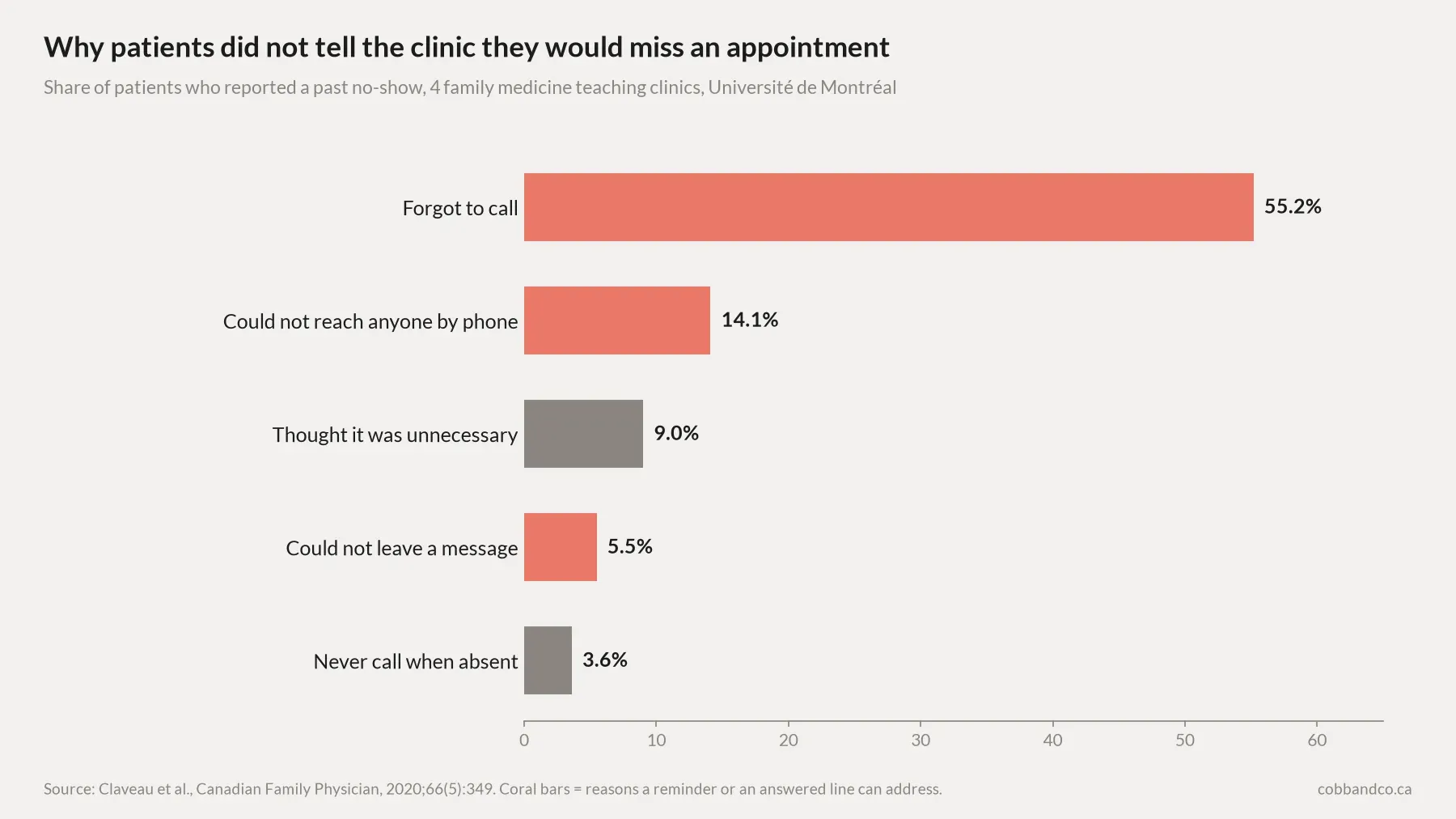
No-show reasons in four Quebec teaching clinics (Claveau et al., 2020).
What an AI receptionist for clinics can actually do
In practice it's a very patient front desk assistant working from a script you approved, and it can't get into any system you haven't connected it to.
The phone and the calendar
It's 5:01, the door is locked, and the line keeps ringing anyway. An AI answering service picks up and works out what the caller wants. It sorts out what it can, and for the rest your staff come in the next morning to a short written note about who called and what they need, with a flag on anything time sensitive. Patients who'd rather text or use web chat can do that too.
Booking is where most of the value is, and honestly most of the work too. The agent has to read and write appointments in the clinic booking software you already use, and it has to follow your rules about which appointment types patients are allowed to book on their own. It also needs to know who sees what and how far ahead people can book, and that usually lives in one person's head at the front desk. If your system has an API or an approved integration, the agent can work with it directly. If it doesn't, the agent can still queue the request for staff to confirm.
Reminders and intake
Most patient appointment reminders today are one-way texts. The patient reads it on the bus and means to call, and then Thursday arrives. When the text is two-way, they can just reply "can't make it," and the agent offers two other slots and books whichever one they pick, while the original time goes back to the waitlist. Nobody at the desk has to chase anyone, and if you're trying to reduce no-shows without adding work for your staff, I think this is the place to start.
Intake forms ride along with the booking. When an appointment is made, the agent sends the right form, say a new patient form or insurance details for a physio or dental visit, and if it's still blank later the patient gets a nudge and anything missing gets flagged for staff.
Sorting calls
You'll sometimes hear the routing part called "triage." I'd be careful with that word, because most people hear it and picture a nurse. The agent works out what the call is about, maybe a prescription renewal request or someone asking about results, and passes it along. Anything that sounds urgent goes straight to a human or gets the right emergency instructions. It doesn't get to decide on its own what's medically urgent. It works from the red flag list you and your clinical team wrote.
A lot of what's left is the stuff your front desk answers fifty times a week, like what time you close on Fridays or whether you take walk-ins, and the classic one at private clinics: Is this service covered or private? Your staff are bored stiff answering these, and an agent handles them easily, as long as the answers come from a list the clinic keeps up to date.
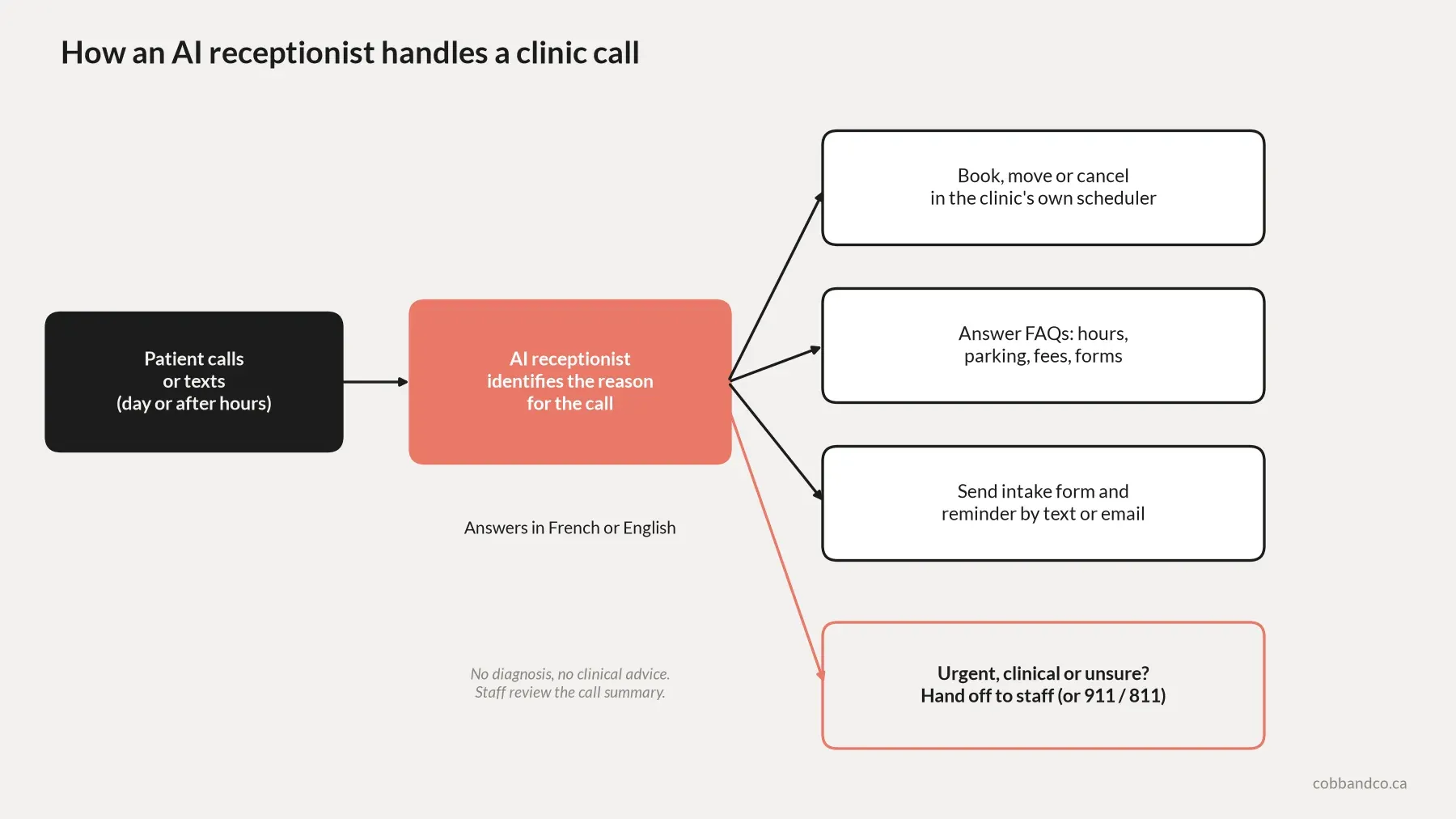
How an AI receptionist handles a clinic call.
What it should not do
Be strict about this part. An AI receptionist shouldn't give clinical advice, interpret symptoms, suggest a diagnosis, comment on test results or tell anyone they don't need to be seen. Full stop. If a caller mentions chest pain, or anything else on your red flag list, the agent gives emergency instructions and gets out of the way. Both provinces have 811, which connects people to a nurse for non-urgent health advice (Info-Santé in Quebec, Health811 in Ontario). Put it in the after-hours script.
Patients also need an easy way out. At any point they should be able to say "I want to talk to a person" and get transferred if you're open, or get a promised callback if you're not. And on your side? Staff should be able to read every conversation, fix the agent's answers and switch a workflow off without phoning a vendor. If a tool can't do that, I'd walk away.
How it fits the systems clinics in Quebec and Ontario already use
Before you buy anything, write down what you already have. A family medicine group in Laval is going to end up somewhere very different from a dental office in North York.
Quebec
Start with the public side. Rendez-vous santé Québec is the free government service, run by the RAMQ, that lets anyone with a health card book online with their family doctor, another professional in their GMF or a clinic nearby. It already sends confirmations and reminders by email, automated call and text. So if your family medicine slots already go through RVSQ, there's no point building a second booking path next to it, and the AI receptionist should either send patients there or work alongside it.
A lot of Quebec clinics also use Bonjour-santé. Its clinic page says its solutions are integrated with the provincial system, free for clinics, and come with a virtual phone assistant. Take ten minutes and check what your current tools already cover before you pay for anything new.
Records are the other piece. The Quebec government's list of DMÉ suppliers names the certified partners the health ministry recommends: Ofys, Myle (MEDFAR), MobileMed, Omnimed and Medesync (TELUS). The ministry also certifies applications by family, and appointment booking is one of those families. Whatever agent you pick has to respect how your DMÉ and your booking tools exchange data, so ask your DMÉ vendor about it early.
Ontario
Ontario works differently. There's no single provincial booking site for family doctors. Health Care Connect helps unattached patients find a provider, and then the provider books that first visit. For booking itself, Ontario Health publishes an Online Appointment Booking Standard that primary care providers and vendors can use when they're choosing online booking for clinics. Among the benefits, it lists automated email, text and voice reminders and reduced no-show rates.
Your EMR matters a lot here. OntarioMD's certified EMR list currently includes Accuro EMR (QHR Technologies), PS Suite EMR (TELUS Health) and OSCAR Pro (WELLSTAR), and they don't all integrate the same way. Ask your vendor what a third party is allowed to read and write before you design anything at all.
Physio, dental and other private clinics
Allied health and dental clinics usually run their own practice software instead of a primary care EMR. Take Jane. On its physiotherapy page, Jane says it's used by more than 4,000 physiotherapy practices and includes online booking, waitlists, and text and email reminders. If your software already handles reminders, AI for dental clinics or physio clinics is really about the phone. Rebooking, mostly. And filling cancellations from the waitlist.
Public sector clinics
Work in a CLSC, a GMF tied to a CIUSSS, a community health centre or an Ontario Health Team clinic? Then you probably can't choose a tool on your own anyway. Procurement comes first, along with privacy reviews and the provincial standards above, which is why a small pilot (reminder calls for one service, say, or after-hours FAQs) is usually the easier way in.
Bilingual service in Quebec
A clinic line in Montreal gets French and English calls all day long. The agent should detect the language and answer in it. In Quebec, it should open in French. Since Bill 96, the Charter of the French language makes the right to be informed and served in French enforceable for businesses operating in Quebec, as the Office québécois de la langue française explains. What does that look like in practice? French scripts written properly in Quebec French by someone who didn't just paste the English into a translator, plus a French version of every text reminder and every intake form you send out. Health services have their own rules about service in English, so ask your organization how those apply to you.
Then check the vendor. Search "AI receptionist Canada" and a lot of what comes up is US products tuned for English and Spanish. Rosie's pricing page, for example, lists English and Spanish on every call and says nothing about French. Don't take anyone's word for it. Test the French yourself, with real calls, before you sign.
Privacy: Law 25, PHIPA and what to ask vendors
Quick note first. This is general information, not legal advice. Talk to your privacy officer, your professional order or a lawyer before patient data goes into any new tool.
In Quebec, Law 25 updated the private sector privacy act (the Act respecting the protection of personal information in the private sector). Before personal information is communicated outside Quebec, and that includes a vendor hosting data somewhere else, the business has to do a privacy impact assessment and have a written agreement that reflects it (Gouvernement du Québec). Health information has its own law now as well. According to the Commission d'accès à l'information, since July 1, 2024 the Act respecting health and social services information applies to many health organizations, private professional practices (cabinets privés) included.
Ontario has PHIPA, which governs how health information custodians collect, use and disclose personal health information. A vendor running an AI receptionist for you is acting on your behalf. How do custodians stay accountable for the people and services handling that data? The Information and Privacy Commissioner of Ontario is the place to read up on that.
Here's what I'd ask any vendor, in either province:
- Where are call recordings, transcripts and messages stored, and can they stay in Canada?
- Will you sign a written agreement that covers confidentiality, access, retention and breach notification?
- Is our data used to train your models?
- How do patients get consent notices, and how do we honour a request to delete or correct their information?
- Who on your side can see our conversations, and is that logged?
I'd also keep the agent's access as narrow as you can. To book someone and remind them, it needs their contact details and an appointment time, and it has no reason to ever see the chart.
What AI receptionists and answering services cost
Setup is where the money goes, in my view, more than the monthly fee. Somebody has to connect the agent to your scheduler and write the scripts in French and in English, then test the urgent call paths and do the privacy work. If you'd rather hand that part off, I've written separately about what an AI consultant costs in Canada.
The prices below come from public pricing pages as of October 2026. The vendors are all US-based and their pages don't show Canadian dollar pricing, so assume US dollars and confirm before you budget. None of this is a recommendation, and picking a vendor doesn't get you out of the privacy and French-language checks above.
Smith.ai's AI Receptionist has a free tier that covers 25 calls a month, and its Pro plan is $150 a month for 75 calls, with an Enterprise plan from $500 a month. It also offers transfer to live agents, according to its pricing page. Rosie sells minutes instead. Its pricing page lists $49 a month for 250 minutes and $149 for 1,000 minutes with calendar booking and live transfers included, and the biggest plan is $299 for 2,000 minutes. Goodcall charges per agent and counts unique callers rather than minutes, at $79, $129 or $249 a month on its pricing page. Put together, a basic AI answering service costs somewhere between tens of dollars and a few hundred a month.
Start small: one workflow first
Don't automate the whole front desk in one go. Honestly, most clinics don't need to. Pick one workflow and run it for a month, then look at the numbers before you add another.
Two-way reminders are the one I'd usually try first. You send them 2 or 3 days before the visit, patients reply by text to confirm or to move the appointment, and any slot that frees up goes to the waitlist. It touches very little data and it's easy to measure, since you only need to compare no-shows before and after, and your staff will see the effect quickly. Most booking and reminder automation projects are built around this.
After-hours calls are the other good candidate. The agent takes the calls while you're closed, mostly FAQs and booking requests, and leaves your staff a summary for the morning. During open hours I'd keep a person on the line at first and only widen the agent's hours once you trust the transcripts.
Whichever you go with, write the red flag list and the handoff rules with your clinical lead before go-live, and test it in both French and English. For the first couple of weeks I'd read the transcripts every day. It's tedious, but that's where you catch the odd answer before a patient does. For where agents fit beyond the front desk, here's how I approach AI agents for small business.
FAQ
Is an AI receptionist the same as an AI answering service?
They overlap a lot, but an answering service mostly takes messages, while an AI receptionist also works inside your scheduler and routes calls, so ask each vendor what theirs can actually do in your system.
Can an AI receptionist give medical advice to patients?
It shouldn't, and a properly set up one won't try. Information you've approved, like your fees or how to prepare for a visit, is fine to share. Anything about symptoms or results belongs with a clinician, and so do treatment questions. An urgent call should get emergency instructions and a human right away.
Does it work with my EMR or clinic booking software?
That depends on whether your EMR or booking tool offers an integration or API that lets an agent read and write appointments, so check with your vendor first. Without one, the agent can still collect requests for staff to confirm.
Is it allowed under Law 25 and PHIPA?
Using a vendor isn't forbidden in either province, as far as I understand it, but you stay responsible for the patient information it handles. In practice that usually means a privacy impact assessment and a written agreement with the vendor. You'd also want clear consent notices, and you should know where the data is stored. I'm not a lawyer and this isn't legal advice, so check with your privacy officer or professional order.
Next step
If you run a clinic in Quebec or Ontario and want to know whether reminders or after-hours booking would pay off for you, book a call with me and we'll look at your phone volume and current tools to pick one workflow worth testing. If you're near Montreal, I've also written about working with an AI consultant in Montreal.
Sources
- CFIB, Patients Before Paperwork, January 2023
- Claveau J. et al., Patients' missed appointments in academic family practices in Quebec, Canadian Family Physician, 2020
- Gouvernement du Québec, Rendez-vous santé Québec
- Gouvernement du Québec, Liste des fournisseurs de solutions de DMÉ
- MSSS, Applications certifiées
- Ontario Health, Online Appointment Booking Standard
- OntarioMD, Certified EMR Offerings
- Office québécois de la langue française, Langue du commerce et des affaires
- Commission d'accès à l'information, Champ d'application de la LRSSS
- Ontario, Personal Health Information Protection Act, 2004